Rules
Every collection has five rules that decide who may do what: list, view, create, update and delete. The same language filters records (?filter=) and realtime subscriptions.
| Rule value | Meaning |
|---|---|
none (null) |
Locked: superusers only. New collections start like this. |
"" (empty) |
Public: anyone, signed in or not. |
| an expression | Allowed when the expression is true for the record and the request. |
Superusers bypass every rule.
How each rule is used
Section titled “How each rule is used”| Operation | When the rule says no |
|---|---|
| list | The record is left out of the results. |
| view | 404, as if the record did not exist. |
| create | 403. The rule sees the new record and the submitted body. |
| update | The record must pass the view rule (else 404), then the update rule, checked against the stored record with the body available (else 403). |
| delete | View rule (else 404), then the delete rule (else 403). |
| realtime | The view rule is checked for every event and every subscriber. |
If you may create or update a record but not view the result, the API answers 204 No Content.
The language
Section titled “The language”status = 'published' && (author = @request.auth.id || @request.auth.role = 'editor')- Operators:
=!=>>=<<=,~(contains, case-insensitive) and!~. Combine with&&,||,!and parentheses. - Values:
'text'or"text", numbers,true,false,null. - Fields of the record by name.
author.namefollows a relation (3 steps at most).comments_via_postreaches the records ofcommentswhosepostpoints here (a back-relation). - Request:
@request.auth.<field>(the signed-in user; every field is empty when nobody is signed in),@request.auth.collection_name,@request.body.<field>(the submitted value on create and update),@request.query.<name>,@request.headers.<name>(lowercase,-written as_),@request.method,@request.context. - Time:
@now,@today_start,@today_end. - Other collections:
@collection.<name>.<field>joins any record of another collection, for example memberships. These lookups ignore the other collection’s rules. Not available in?filter=. - Modifiers:
field:length(number of values),field:lower,field:each(each value of a list on its own),@request.body.field:isset(the field was sent). - Functions:
lower(x),upper(x),len(x),coalesce(a, b),date_add(date, 'P1D'). - Comments:
// …until the end of the line, in stored rules.
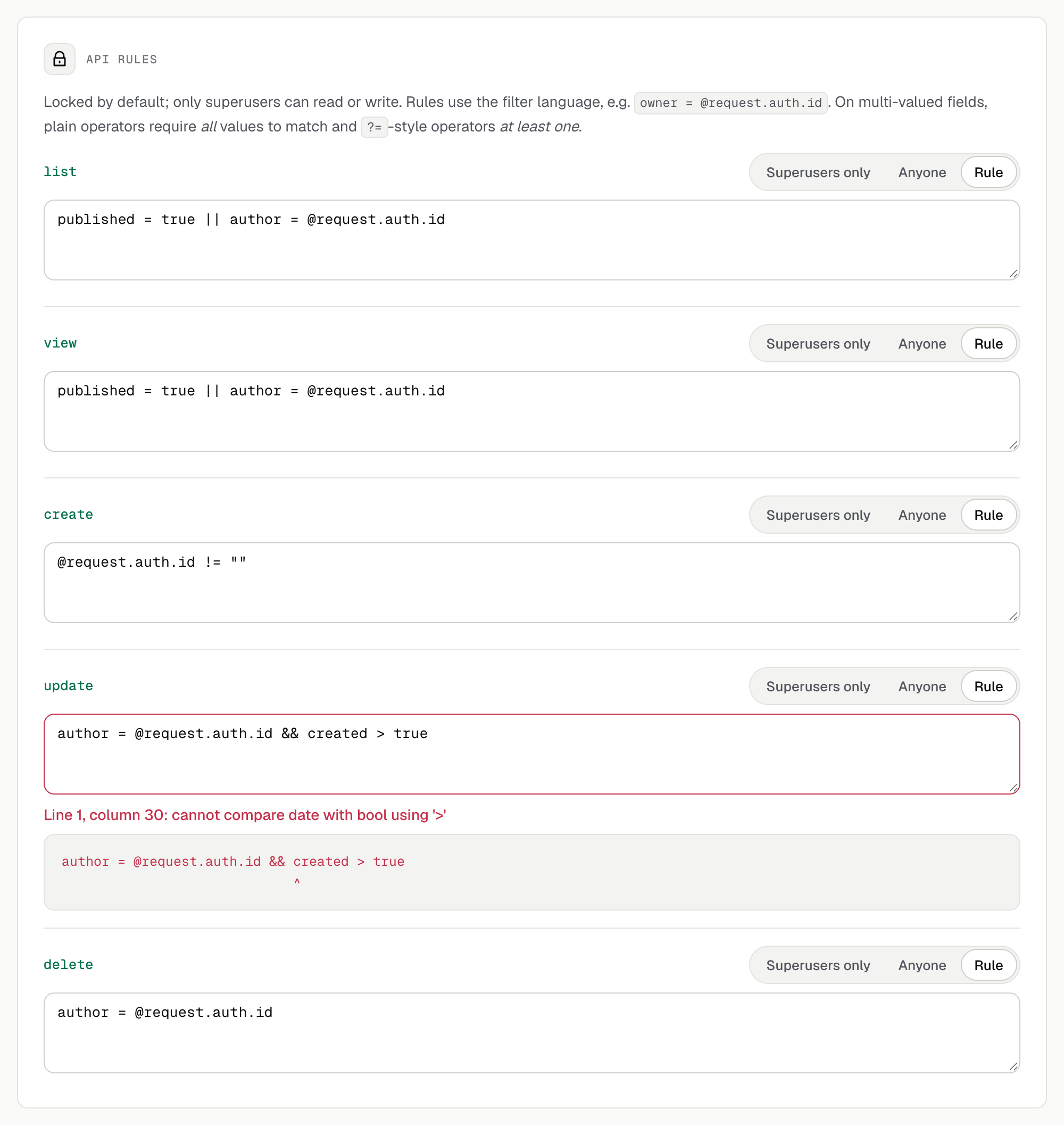
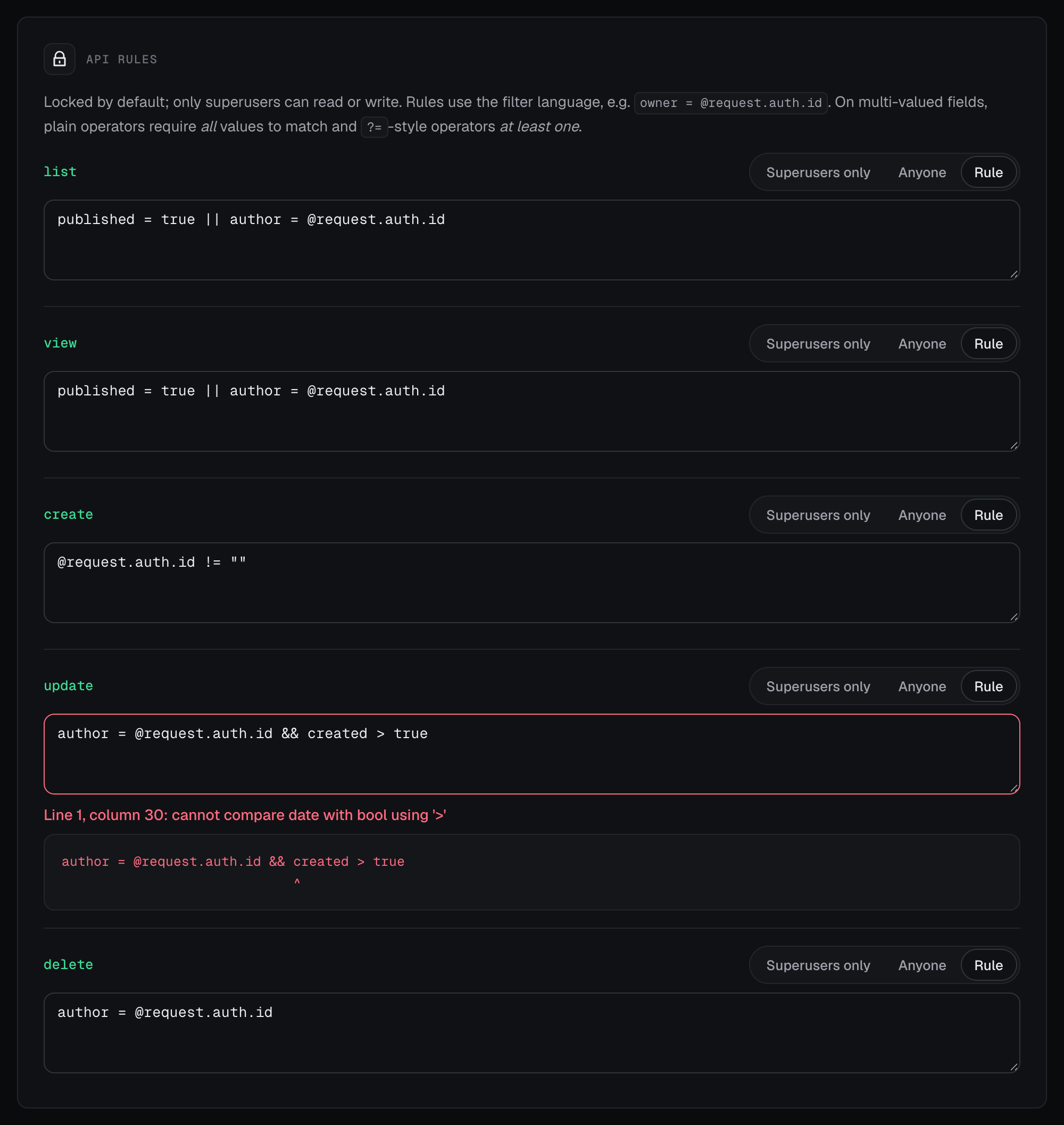
Rules are type checked when you save them: comparing a date with a boolean, or naming a field that does not exist, is an error with its position. The admin UI shows it as you type; POST /api/rules/check does the same for scripts.
Empty values
Section titled “Empty values”null and '' both mean “empty”: x = null matches a value that is null or an empty string, and so does x = ''.
Any other comparison with an empty value is false. So author = @request.auth.id is false for every record when nobody is signed in, and false for records without an author. To require a signed-in user, write:
@request.auth.id != ''Lists of values
Section titled “Lists of values”Some operands hold several values: multi-value select, relation and file fields, back-relations, :each, and paths through them. For those:
- plain operators mean all: every value must satisfy the comparison;
?operators mean at least one:?=,?!=,?>,?>=,?<,?<=,?~,?!~.
With an empty list, a plain operator is true (nothing fails) and a ? operator is false (nothing matches).
| Rule | tags = ['a','b'] |
tags = ['a'] |
tags = [] |
|---|---|---|---|
tags ?= 'a' (has an a) |
true | true | false |
tags = 'a' (every tag is a) |
false | true | true |
tags ?!= 'a' (has something other than a) |
true | false | false |
tags != 'a' (no tag is a) |
false | false | true |
tags:length > 0 && tags = 'a' (only a, not empty) |
false | true | false |
Typical patterns:
// the user is one of the record's members (multi relation)members ?= @request.auth.id
// none of the record's labels is "secret"labels != 'secret'
// the post has at least one approved comment (back-relation)comments_via_post.approved ?= true
// the user belongs to the record's team (membership collection)@collection.memberships.team = team && @collection.memberships.user = @request.auth.id
Recipes
Section titled “Recipes”Owner only:
@request.auth.id != '' && owner = @request.auth.idCreate only as yourself (the create rule sees the new record):
@request.auth.id != '' && owner = @request.auth.idNever change the owner on update:
owner = @request.auth.id && (@request.body.owner:isset = false || @request.body.owner = @request.auth.id)Published, or your own drafts:
status = 'published' || (@request.auth.id != '' && author = @request.auth.id)Users of a specific auth collection:
@request.auth.collection_name = 'staff'Verified accounts only:
@request.auth.email_verified = trueFilters
Section titled “Filters”GET /api/collections/{c}/records?filter=… uses the same language. The filter is combined with the list rule, so it can only narrow what you may see. @collection is not allowed in filters, so clients cannot probe other collections.
?filter=created >= @today_start && title ~ 'report'?filter=tags ?= 'urgent'?sort=-created,titleFilters on hidden fields (an auth collection’s email when emails are not visible) are refused for everyone but superusers.